
About this article: Understanding the Chambers & Partners research process is essential for law firms looking to improve their rankings and submissions. In this article, we break down how Chambers & Partners evaluates firms, what researchers look for, and practical tips to strengthen your submission strategy.
On 28th April, we conducted a webinar regarding the internal ranking process at Chambers & Partners. The webinar was hosted by Blessing Adeagbo and Lena Martin, moderated by Laurence Mussett, and featured guest speaker Ana Licurci, Research Manager at Chambers & Partners.
We were delighted to see such a high level of attendance. Thank you again to everyone who joined us! As always, to ensure no one misses out, we’ve put together the key takeaways from the session.
Who This Article Is For
- Law firm marketing and business development teams
- Partners preparing Chambers submissions
- Firms aiming to improve or secure Chambers rankings
Quick Overview
The webinar began with an overview of Chambers’ submission process, including important 2026 deadlines, key ranking components, and what firms need to know to succeed. This was followed by a focused session on how to write compelling work highlights and what strong client feedback looks like, along with additional practical tips.
We concluded with a live Q&A session and we were very excited to receive an overwhelming number of questions. For those that we were not able to answer in the session, we have given our responses to the remaining queries at the end of this article.
Upcoming 2026 dates
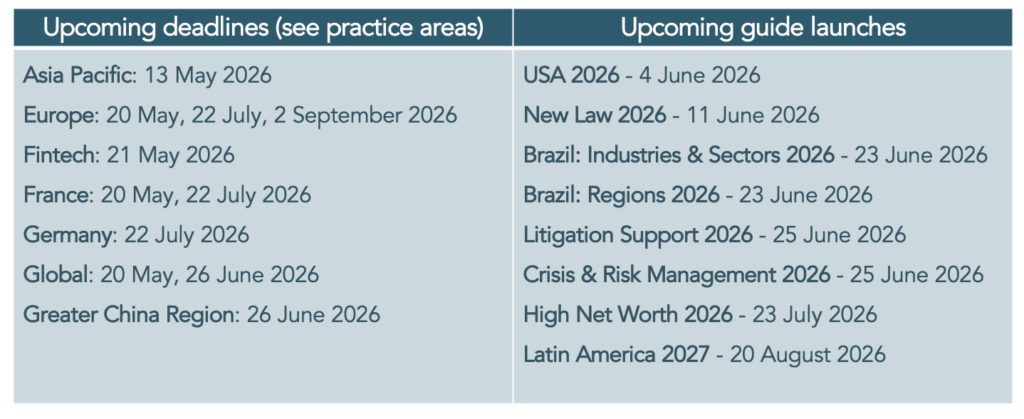
Understanding the Chambers & Partners Research Process
Chambers & Partners research is structured in 5 key phases, which the researcher will have to go through each time they are researching a practice area.
- Preparation – Researchers meet with ranking editors to discuss market trends, recent developments, and objectives for the upcoming research (table refinement, new subtables, etc.).
- Interviews – Researchers speak with lawyers and clients to collect feedback via calls or surveys.
- Ranking – All the information gathered is analysed by the researcher, including submission as well as feedback from peers and clients.
- Editorial – The researcher will select quotes from clients, and matter examples and will check that the description of the firm/lawyer is still accurate.
- Publication – After internal review, guides are published.
Tips:
- Submissions are assessed annually, so consistency in both performance and participation is essential.
- Submit referees on time to ensure they are contacted when the research starts. Be sure to send them your own reminders as this vastly improves the chance that they will respond.
- Make sure the lawyers are available to the researcher for calls
Key Criteria Behind Chambers Rankings
Chambers rankings are based on four key factors:
- Work highlights: The researcher will assess the sophistication of the matters submitting using the submission.
→ What does sophistication actually entail? This term refers to the complexity, scale, or strategic importance of your work. Factors include:
- The prominence of the client or transaction in the market
- Legal or jurisdictional complexities involved
- Novel issues handled, or innovative approaches
- The firm’s specific role and impact on the outcome
Note: Matters don’t have simply to be the highest-value deals; complex regulatory or cross-border work can be equally impressive, as are those that are very unusual or set precedent. Those factors really depend on the practice area.
- Referee feedback: What your referees say about you in surveys or interviews. Strong client feedback can have a significant impact on rankings, particularly when a researcher is undecided about a potential promotion.
- Bench strength (for firms) and individual involvement (for lawyers): The researcher assesses the depth and quality of the team, or how actively a lawyer contributes to matters.
- Finally, market feedback: What peers say about a lawyer or a firm. It has the least weight but can still influence decisions if consistently positive or negative.
Tips:
- Write matters clearly, concisely, and easy to understand (max. 1 page)
- Focus on quality: the submission allows for 20 matters, so be sure to focus on your strongest work.
- Showcase new work where possible and add clear updates if using matters that have appeared recently.
- Complete as many fields as possible where feasible for confidential matters and only use N/A when strictly necessary
- Include lawyers from other departments where relevant to help show your bench strength, especially for co-led or cross-practice matters.
How to Write Strong Work Highlights for Chambers Submissions
A well-structured matter description helps researchers quickly understand the importance of your work.
We recommend the following structure:
- The client is identified clearly and concisely. Don’t assume the researcher knows every market player— adding brief context helps them understand both the matter and its significance.
- The transaction is clearly explained and outlines the firm’s role and key responsibilities (current and ongoing).
- The firm highlights why the deal is complex, impactful, or significant—making clear why it deserves inclusion. This is crucial, as excessive or overly technical detail can obscure what the matter’s impact was.
- A closing sentence highlighting why the matter shows the firm’s strengths. This can help underscore the strength of the deal.
Tips:
- Keep work highlights concise and impactful, ideally within one page per matter.
- It’s also fine to include confidential matters: Chambers handles all data with care, and confidentiality does not make a matter any less strong or valuable.
What about matter values?
Matter value is not always decisive, but it can provide useful context. Below are some tips:
- Use the correct value: Showcase the matter/transaction value, not the enterprise value.
- Value is a good indicator, but it isn’t everything: Don’t exclude matters just because the value is lower—complexity, jurisdictional challenges, or client importance can make them equally significant.
- Highlight broader complexity: Emphasise what makes the matter notable beyond value (e.g. legal difficulty, strategic importance, timing).
- Include values where possible: It’s better to include a matter than omit it, as each adds to the overall picture.
- Handle confidentiality smartly: If exact figures are sensitive, provide a value range instead.
- Consider practice area differences: In areas like disputes, value may matter less, but including it where possible still helps give context.
How to Secure Strong Referee Feedback for Chambers
Referee feedback is one of the most influential ranking factors, often carrying even more weight than work highlights.
Tips:
- Choose referees who are responsive and available, not just the most senior.
- Prepare them by explaining Chambers’ role and expectations, so they don’t mistake outreach for spam.
- Encourage written responses if calls aren’t possible. Feedback in any form counts.
- Spread referees strategically, so that newer partners receive exposure and are well positioned for consideration too.
- Never “coach” referees, but ensure they understand what Chambers is looking for. The main themes to their feedback should be the firm’s quality of advice, commercial awareness, and sophistication of service.
Consistent, positive feedback over multiple cycles signals reliability and will therefore lead to new or improved rankings.
Demonstrating Bench Strength in Chambers Submissions
Chambers looks beyond individual partners.
To demonstrate strength:
- Include a range of lawyers across seniority levels
- Highlight collaboration across teams and jurisdictions
- Show continuity and depth within your practice
Consistency in Chambers Submissions Matters
Skipping a year or submitting partial information can negatively affect rankings. Chambers really values steady participation and evidence of ongoing excellence — not sporadic peaks.
If a ranked lawyer isn’t included in a submission, Chambers will monitor their performance the following year before making any ranking changes.
Final Thoughts
To stand out in your submissions to Chambers going forward:
- Submit every year
- Keep matters current (12-15 months max.), clear and easy to understand
- Make sure you explain why the matter is important/complex/challenging etc.
- Prioritise available and willing referees above all others.

Remaining Q&A questions:
1. I have observed through the last years that Chambers send the questionnaires to selected referees – not all. Does it go in stages or just a part of all referees provided by a law firm?
Usually, referees are contacted around the same time, whether for calls or surveys. However, in larger sections, outreach may be staggered.
The split between survey and call invitations can vary. Typically, call invites are sent to referees with a higher number of referrals, while surveys go to the rest. Some sections may follow a 50/50 split, but this is flexible.
It is at the researcher’s discretion who they invite to calls, but ultimately Chambers will try to speak to as many referees via phone interview as possible.
2. What if a matter is very sensitive and barely any information can be shared?
If you already have enough strong matters, it may not be necessary to include it. However, if the client is notable, you can still list them in the confidential client section (Section E0) to demonstrate that you act for them.
You’re always welcome to include clients in the confidential section—Chambers treats this information seriously, and confidentiality does not weaken the strength of your submission.
Consider whether you have enough disclosable information to give the researcher a fair impression of what the matter was and why it was important. If you do not have enough information, you may wish to consider including other matters.
3. I would like to understand how we should reflect a situation where we handle multiple engagements for a single client — for example, an ongoing general advisory mandate alongside a new, distinct matter. Should these be listed as separate entries within the same client reference, or is there a preferred format for combining them into one submission?
We usually recommend listing all the deals you’ve handled for a single client under one matter description, but it’s important to clearly distinguish between different engagements—for example, ongoing advisory work versus a specific litigation matter. This approach also helps free up space to highlight work for other clients.
4. I had the benefit of going through a survey with a lawyer and I notice that the questions aren’t the same as these. Are these specifically the questions that would be asked in an interview?
The sample questions shown during the webinar reflect the general theme of the questions that referees would typically be asked on calls and in surveys/questionnaires. They will likely be questions that researchers will ask in phone interviews. The questions may not be in the same exact words as in the surveys, but the general ideas that Chambers & Partners want to find out about are the same.
5. Is it better to have referees who can speak specifically to matters that we have submitted? Sometimes we need to drop matters because others are more impressive but the referee is still one that we would like to put forward. Is it stronger to have the referees that can talk to the specific matters that we do select for consistency?
Referees do not necessarily need to align with specific matters. This is encouraged where possible, as researchers can then corroborate a matter in the submission with feedback from someone else who worked on it. However, if the firm has a solid referee who is likely to respond and provide helpful feedback, the referee should not be dropped simply because their matter is not featured on the submission.
6. It was mentioned that the “referring lawyer” column in the referee spreadsheet is helpful, but that’s only relevant for referees who have calls with Chambers right? Most referees receive a survey and in that case that column is irrelevant.
Yes, referees who receive surveys are required to select lawyers from a dropdown menu. However, the “referring lawyer” field should always be completed if possible because they are helpful to researchers when they conduct phone interviews
7. Is it worth describing in the work highlight who worked on the case, given that the team composition is already included in the dedicated row? Isn’t it a waste of characters?
While completing the dedicated field in the work highlight form is crucial, also indicating which lawyers or teams worked on specific aspects of a matter can help clarify roles and responsibilities—especially when multiple partners are involved across different departments, or when you are aiming to have a particular lawyer recognised.
In short, this is optional, but worthwhile if you have the space and a clear reason to mention specific lawyers during the matter description.
8. Given the form encourages us not to just submit lawyer bios that are already available on the website, what are things that can be added to lawyer bios would catch the eyes of Chambers?
We recommend including a hyperlink to the website bio within the individual’s name.
A strong bio should ideally be structured within 150–200 words and include: a brief overview of expertise and education, key track record highlights, ongoing or recent major work, notable publications (if relevant), and a clear indication of where you believe the individual should be ranked.
9. Is it possible to include some confidential details in a disclosable work highlight? If yes, how? Putting sensitive information in red ? Or when in doubt just put it in the non-publishable work? (Some elements of our transactions are public while some aspects we worked on are confidential).
Where a matter combines publishable and non-publishable elements, the matter can be included in the publishable section with the non-publishable aspects written in red font. However, if by nature, the matter is very sensitive and has more confidential aspects, it may be helpful to have the matter in the confidential section. As mentioned earlier, Chambers pays equal attention to publishable and confidential matters.